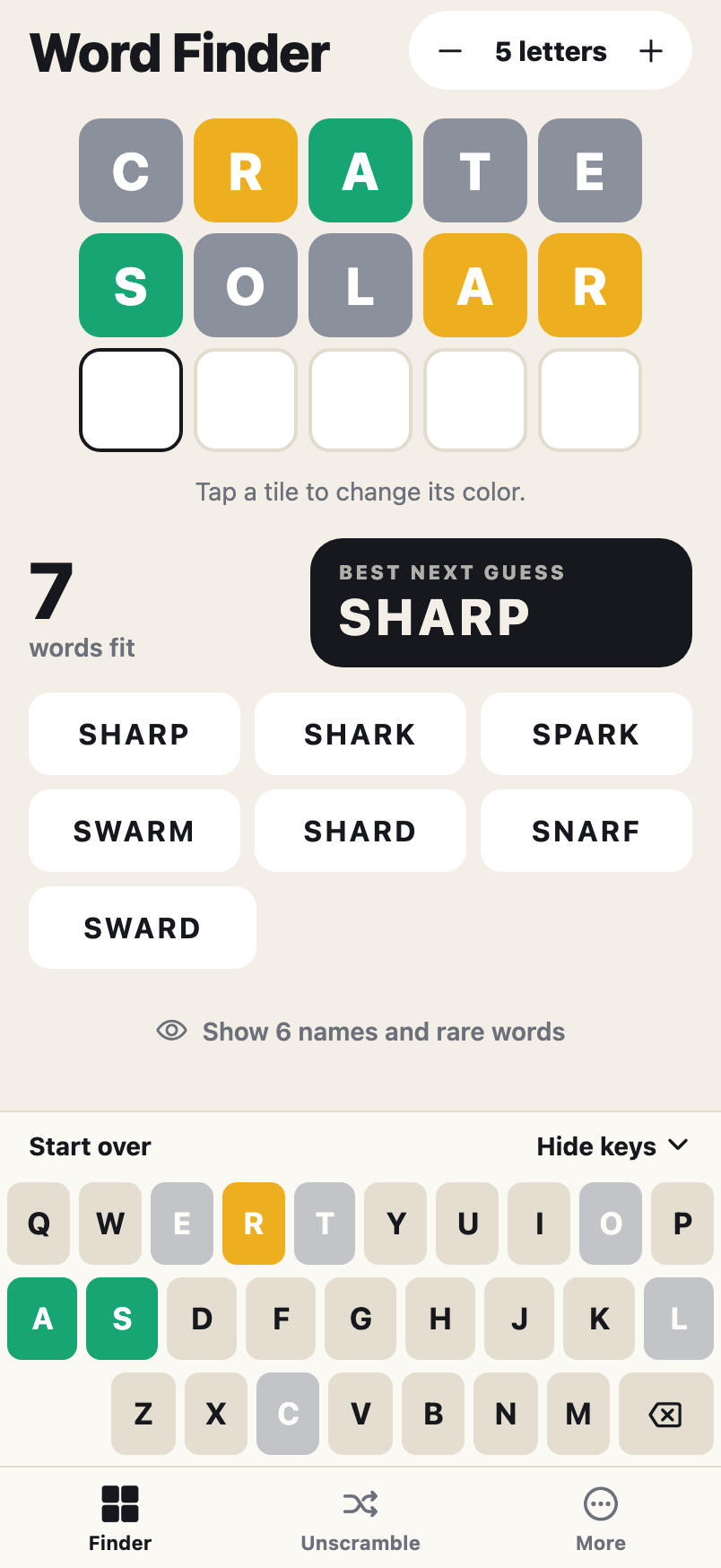
Place them exactly where they appeared in the game.
Global excluded:
* Grey duplicate letter (exact count limit applied)
CRANE👆
Double-check the white-ringed letters.
Retype your guesses, tap each tile until it matches your color, then Solve.Type the letters you know - green in their spot, yellow anywhere - then Solve.
Tell the solver what your guesses showed and it lists every word that can still be the answer, with the most common words first. It works as a Wordle helper when you are stuck on guess three, and as a plain 5-letter word finder when you only know a few letters.
Enter your guesses. Type them on the board, or paste a screenshot of your game and the board fills itself in.
Match the colors. Tap each tile until it shows what Wordle showed you: green for the right spot, yellow for the wrong spot, gray for a letter that is not in the word.
Press Solve. You get every 5-letter word that still fits your clues.
Pick your next guess. Switch the sort to Best Guess to see which word narrows the list the most, then come back after your next guess.
Not playing Wordle? Fill in only the letters you know and use the list as a 5-letter word finder for crosswords and other word games. For shorter or longer words, open Other lengths next to the page title.
Wordle Solving Strategy
Good Wordle play is not about memorising one magic word. It is about making each guess separate the answers that are still possible. These techniques do that, and where we can we have checked them against our own archive of past answers rather than repeating what everyone else says.
Start with a word that mixes common consonants and vowels. CRATE is our practical default, and TRACE, SLATE and RAISE are all close behind. The gap between the good openers is small, so pick one you can remember and spend your attention on reading the board afterwards.
A fixed pair of opening words is easy to remember, but it is not the strongest way to play. Your second guess is worth more when it answers what the first result actually revealed. If you like a routine, these pairs cover ten different letters:
Two-word routines:
CRATE + SHOULD-style follow-ups - test five fresh letters
STARE + CLOUD - covers S, T, A, R, E, C, L, O, U, D
SLATE + CRONY - covers S, L, A, T, E, C, R, O, N, Y
Just do not play the second word on autopilot. If your opener already turned three letters green, a rigid second guess spends a turn testing letters that no longer matter.
📐 What our own data says about starting words
We scored these openers against every one of the 1,880 different answers Wordle has used, counting how much each guess narrows the field. More information is better; fewer answers left is better.
Opening word
Information (bits)
Answers left on average
SOARE
5.902
48.7
TRACE
5.875
56.0
CRATE
5.873
55.4
IRATE
5.872
49.5
SLATE
5.854
57.5
RAISE
5.835
50.4
ADIEU
4.879
98.5
Four vowels look tempting, but ADIEU leaves about 98 possible answers where CRATE leaves about 55. Testing common consonants alongside vowels tells you more.
Don't just think about letters - think about word structures. When you identify a pattern, consider which letters commonly appear in that position.
Example: If you see _ _ A C K, the probability heavily favors:
T → TRACK
S → STACK, SLACK, SMACK, SNACK, SHACK
B → BLACK
C → CRACK
W → WHACK
Understanding these patterns helps you make smarter guesses based on common English word formations rather than random letter attempts.
🛡️ Normal Mode Strategy: The "Elimination Word"
The dreaded "rhyme trap" occurs when you're stuck with a pattern like _IGHT or _OUND. In Normal Mode, the most efficient way to escape is using a strategic "elimination word."
The Problem:_IGHT has 9+ possibilities: NIGHT, LIGHT, TIGHT, MIGHT, etc.
The Solution: Instead of guessing one by one, use a "filler word" like FLOWN or CLEFT that tests several of the missing first letters at once.
How much it helps: say FIGHT, LIGHT, MIGHT, NIGHT and RIGHT are all still possible and you have two guesses left. Guessing one of them wins about 40% of the time. Playing FLAME instead - a word that cannot be the answer - separates FIGHT, LIGHT and MIGHT from each other and lifts your chance to 80%.
That is the whole idea behind information-based play, and we work through it step by step in our strategy article.
🛡️ Hard Mode Strategy: Surviving the Rhyme Trap
In Hard Mode, the "elimination word" strategy (guessing a completely unrelated word) is illegal. You must use every revealed hint, which can lead you into a "Rhyme Trap" where you're forced to guess similar words one by one.
1. When to Act: The Prevention Window
The secret is to act before the trap snaps shut. If you have _ I _ _ T, don't rush to lock in the G and H.
The Pro Move: Use your open slots to test potential prefixes. Instead of guessing LIGHT, try FLINT or FIRST.
FLINT tests F, L, N while obeying the rule to use I and T.
FIRST tests F, R, S while obeying the rule to use I and T.
By "wasting" a turn to test multiple consonants, you gain the information needed to solve the puzzle in the next move.
2. The Point of No Return: If You're Already Trapped
What if you've already locked in 4 letters like _ I G H T? In Hard Mode, you are now at the mercy of luck, as you must guess words fitting this pattern.
The Survival Logic: Since you can't use elimination words, your only weapon is Letter Frequency. Don't guess obscure words like WIGHT or EIGHT first.
Follow the mathematical probability:
LIGHT or NIGHT (High frequency)
FIGHT or MIGHT (Medium frequency)
WIGHT (Last resort)
The Bottom Line: In Hard Mode, the best strategy is never letting the 4th green letter lock you in until you've narrowed down the possibilities.
📊 Letter Frequency by Position
Where a letter tends to sit matters more than how common it is overall. These figures come from counting every answer Wordle has actually used, not from general English text:
Position 1 (First letter):S is the most common opener (14.7%), then C (8.8%), B (7.4%) and T (6.6%)
Position 3 (Middle letter):Vowels dominate - A (14.4%), O (11.2%) and I (10.9%) are your best bets
Position 5 (Last letter):E leads by a wide margin (19.7%), then Y (13.9%), T (11.3%) and R (8.5%)
Pro tip: E shows up in 47% of all answers and A in 40%, but position is what wins guesses - S rules the first slot, while E and Y own the last one.
✨ 30 Solid Starting Words
Any of these makes a reasonable opener. The first few score best in our own testing; the rest are still good, and a word you remember beats a better word you forget:
SOARE
TRACE
CRATE
IRATE
SLATE
RAISE
SALET
ARISE
AROSE
TARES
ROATE
REAST
CRANE
STARE
HASTE
LEANT
SABER
TEARY
STORE
STERN
SNORT
TRAIL
AISLE
OCEAN
CLINT
ROUND
ABOUT
PIOUS
ADIEU
AUDIO
Pro tip: If you play a second fixed word, pick one that shares no letters with the first - CRANE + SHOUT tests 10 different letters. But once the board shows you something, let it change your mind.
Wordle Statistics & Global Benchmarks
Explore our Wordle Statistics - updated every 1-3 days with difficulty estimates that combine lexical features and quality-checked search-demand trends.
🌍 Global Performance Benchmarks
How smart are you compared to millions of Wordle players worldwide?
Genius Zone
1-2 guesses
Luck + exceptional skill. Only ~1% of players achieve this regularly.
Solid Zone
3-4 guesses
Strategic thinking pays off. This is where most skilled players land.
Average
3.9 guesses
The global average. You're right in the middle of the pack!
Danger Zone
5-6 guesses
Cutting it close! Time to brush up on strategy.
💀 The Streak Breakers (Hall of Infamy)
These historically difficult words have ended countless winning streaks. Learn why they're so tricky:
PARER
~48% failure rate
Double letters + obscure word = disaster
MUMMY
~42% failure rate
Triple M? Nobody saw that coming
WATCH
~38% failure rate
Common word, but W + TCH ending is brutal
FOYER
~35% failure rate
French origin, unusual letter combo
VIVID
~33% failure rate
Double V? That's just cruel
SWILL
~31% failure rate
Double L + uncommon vocabulary
🍀 Statistically Best Starting Words
Based on analysis of the last 365 days, these opening words have led to the fastest average solve times:
1CRANE3.42 avg guesses
2SLATE3.44 avg guesses
3TRACE3.46 avg guesses
4CRATE3.47 avg guesses
5STARE3.48 avg guesses
📅 The "Weekend Effect"
Interesting data pattern: Global solve rates drop slightly on weekends! Players are about 8% less likely to solve in 3-4 guesses on Saturday and Sunday. Some call it the "Sunday Scaries" - when relaxed weekend brain power meets a tricky word.
Most common letters at each position
S15.4%A14.2%A14.3%E11.8%E14.9%
C11.3%O10.5%I10.2%N10.0%Y9.3%
B8.5%R9.5%O9.4%S8.2%T8.6%
T7.8%E7.9%E7.4%A7.3%R7.9%
P6.6%I6.7%U6.8%L6.5%L6.6%
Most common letters
E10.7%
A8.4%
R7.9%
O6.6%
T6.3%
L6.1%
I5.9%
S5.8%
N5.2%
C4.3%
U4.1%
Y3.8%
D3.3%
Least common letters
X0.2%
Z0.3%
Q0.4%
J0.5%
V1.6%
W1.7%
K1.9%
F2.5%
B2.7%
G2.8%
M2.9%
P3.4%
H3.5%
Typed "worlde solver"? This is the page you meant
Wordle is an easy word to mistype, especially on a phone. In the searches that bring people here, the slip we see most, by a long way, is worlde, followed by worldle, wordl, wordel, wirdle and wrodle. Whichever one you typed, you have reached the same free Wordle solver, and it does not care how you spelled the name. The same goes if it was solver that came out wrong: sovler, slover and sover all land here too. Scroll back up, enter your guesses and press Solve.
One thing worth saying plainly about worldle: it is not always a typo. Worldle is also a separate daily game where you guess a country from its outline. If that is the one you wanted, this page will not help - we solve word puzzles, not maps. If you just hit an extra L, carry on.
Wordle Solver FAQ
Master the game with the internet's most advanced, data-driven toolkit.
What makes this Wordle solver different from others?
Unlike basic tools that just list words alphabetically, we provide intelligent word frequency sorting to help you pick the most probable answers first.
Our platform is an all-in-one ecosystem for enthusiasts: we offer a comprehensive Past Wordle Answers Archive for cross-referencing, and a dedicated Wordle Statistics dashboard that analyzes global player data and daily difficulty trends.
Plus, with specialized solvers for lengths from 3 to 18 letters, we provide the same high-quality UI/UX for every variant of the game.
Which word-game tool should I use?
Use this solver when you have green, yellow, and gray tile feedback and want to narrow the possible answers. If you have finished a puzzle and simply want another round, play Wordle Unlimited with no daily wait.
Working with loose rack letters or a Scrabble-style board instead? Word Unscrambler is built for rack searches, blank tiles, legal board placements, and scoring moves.
How are the word frequencies determined, and where does the data come from?
Our unique frequency ranking system is built on a massive analysis of open-source linguistic big data, primarily sourced from the Google Books Ngram corpus and other extensive digital libraries.
By processing billions of words across centuries of literature, we categorize every potential answer into 30 distinct frequency tiers. While most results match daily intuition, you might occasionally see a statistical ranking that reflects formal writing trends.
This data-driven approach ensures you prioritize common everyday words - the most likely puzzle answers - over obscure terms.
Is Wordle getting harder?
This is a common myth - and the statistical answer is no!
When The New York Times took over, they actually removed obscure or archaic words from the solution list. The game is, if anything, slightly more accessible now.
If you want to explore the estimates, visit our Wordle Statistics and Difficulty Analysis. Scores combine word structure and frequency with quality-checked search-demand observations; they are not direct player completion statistics.
It only feels harder due to negativity bias: we remember a single failure like PARER or MUMMY far more vividly than our twenty easy wins.
Is Wordle Solver Pro affiliated with The New York Times?
No, Wordle Solver Pro is an independent, third-party companion tool.
Wordle is a registered trademark of The New York Times Company. This website is not affiliated with, sponsored by, or endorsed by the NYT. Our platform serves as an educational and strategy resource for the global word game community.
Wordle History & FAQ
The story behind the squares - discover how a simple love gift became a global phenomenon.
Who created Wordle and why?
Wordle was created by Josh Wardle, a software engineer from Brooklyn. Originally, it was a love gift for his partner, Palak Shah, who loved word games.
Josh built the game during the COVID-19 pandemic as a private project for the two of them. The name "Wordle" is a clever pun on his surname, "Wardle."
When did Wordle go viral?
Wordle launched publicly in October 2021. Its growth was explosive: jumping from 90 players in November to over 2 million daily players by January 2022.
The Secret Weapon? The genius "share" button that generated those iconic colored grids (🟩🟨⬜) without revealing the answer. This allowed people to flex their scores on social media, creating massive curiosity and FOMO.
Why did the New York Times buy Wordle?
In January 2022, The New York Times acquired Wordle for a reported "low seven figures."
The Strategy: Wordle perfectly complemented their world-class games portfolio, including the Crossword and Spelling Bee. It serves as a major gateway for the NYT's subscription ecosystem while remaining free for the general public.
What is the best starting word for Wordle?
Based on linguistic frequency analysis, the most mathematically optimal starting words are CRANE, SLATE, TRACE, or STARE.
These choices maximize coverage of high-frequency vowels (A, E) and common consonants (R, S, T, N, L). Using a word with five unique, common letters is the most efficient way to eliminate thousands of possibilities in a single move.
How many possible 5-letter words are there in Wordle?
Wordle operates using two distinct lists:
~2,300 solution words: Common English words curated to be daily answers.
~10,000+ accepted guesses: The broader dictionary of valid words you are allowed to enter.
Solution words are hand-picked to ensure the answer is always a word that a typical player would recognize, excluding very obscure terms or proper nouns.
New on the 5-letter Wordle Solver: the Strategy Coach. When your list is full of words that differ by one letter, like _IGHT, it suggests a guess that tests several letters at once and shows how it splits the list. It follows Hard Mode rules and changes its advice on your last two guesses. Read how it works.
Our app is out. Word Finder Pro puts the word finder and the anagram solver on your phone, with a dictionary built in, so it works offline too. It is free on Google Play for Android now, and the iPhone version is on its way.
Added acned, admen, adeem, advew, ackee, axmen, apeek, and abbed to WordleSolver and its word lists; thanks for helping improve them.