When you hit a tough Wordle board with dozens or hundreds of candidates remaining, your natural instinct is usually to guess the most common English word left on the list. If you see NAMES, CASES, and MAKES, picking NAMES feels safe because it is familiar.
In game theory and information theory, that instinct is often a trap.
Picking a word just because it is common only tells you whether that single word was the answer. If it is not, you might eliminate only one word while learning very little about the remaining candidates. To solve puzzles in the fewest average turns, you need a guess that cuts the field into pieces, regardless of whether your guess happens to be the secret answer.
That is why we introduced the Best Guess feature in WordleSolver Pro.
The Problem: The High-Candidate Impasse
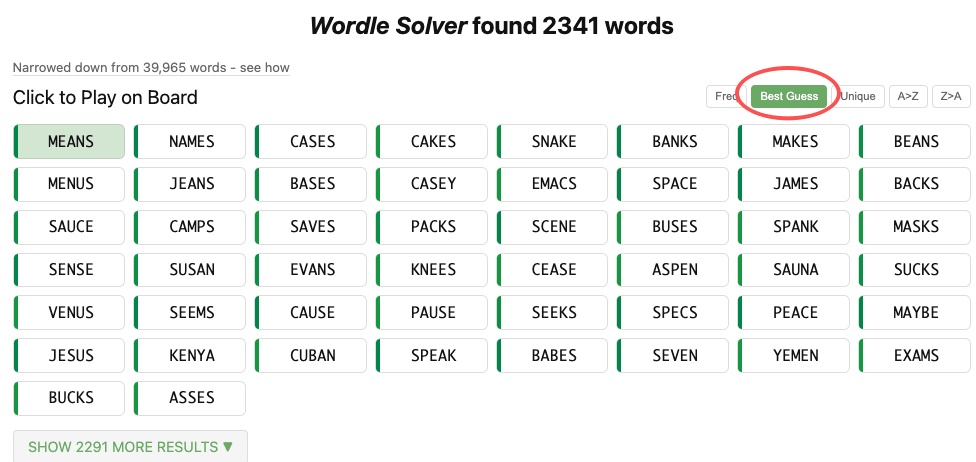
Consider the screenshot above from WordleSolver Pro. After entering initial clue constraints, the solver narrowed down the initial English dictionary of 39,965 words to 2,341 viable candidate words.
At this stage, you have five sorting tabs to help you decide your next move:
- Freq (Frequency): Sorts words by how often they appear in everyday English usage.
- Best Guess: Ranks words by mathematical elimination power (highest Shannon entropy).
- Unique: Sorts words by the count of distinct letters to maximize clue discovery.
- A > Z / Z > A: Alphabetical sorting.
When Best Guess is selected (highlighted in green), the engine evaluates every word in the candidate pool against all other candidates to determine which guess eliminates the greatest number of possibilities on average. In this example, the word MEANS rises to the top spot.
Why does MEANS beat other common candidates like NAMES or CASES? Because the combination of M, E, A, N, and S partitions the 2,341 candidate words into the most evenly distributed feedback patterns possible.
The Mathematics of Elimination
Every Wordle guess returns one of 243 possible color patterns (35 = 243). Each tile is either green (2), yellow (1), or grey (0).
If a guess places all 2,341 candidates into a single bucket (for example, if almost every word shared the exact same letters), receiving that pattern would tell you almost nothing. The ideal guess divides the candidates evenly across many small buckets.
1. Shannon Entropy (Information Gain)
Information theory measures the uncertainty removed by an outcome using Shannon entropy, expressed in bits:
H(g) = -∑r p(r) log2 p(r)
Here:
- g is the candidate guess being evaluated.
- r is a specific 5-tile feedback pattern (such as green-grey-yellow-grey-grey).
- p(r) is the probability that pattern r occurs, calculated as the count of remaining answers that would produce pattern r divided by the total number of remaining candidates N.
Each bit of entropy represents a halving of the candidate pool. A guess that provides 4.0 bits of information reduces 2,000 possibilities to approximately 2000 / 24 = 125 on average.
2. Expected Remaining Pool Size
Another way to understand elimination power is the expected remaining pool size after your guess:
E[C] = ∑r nr2N
Where nr is the number of candidate words that fall into bucket r. Because nr2 squares the size of each bucket, guesses that leave large "clumps" of uneliminated words are heavily penalized. The word with the highest entropy always minimizes the average number of words you will have to search through on your next guess.
Best Guess vs. Frequency: When to Use Each
Understanding the difference between the Freq sort and the Best Guess sort is key to mastering Wordle:
| Scenario | Recommended Filter | Why |
|---|---|---|
| 20+ words remaining | Best Guess | Maximum information gain. You need to carve down a large field quickly. |
Dangerous endgame (e.g. _IGHT) | Best Guess | Tests multiple ambiguous consonants at once to avoid losing on guess 6. |
| 2 to 3 words remaining | Freq | When the pool is tiny, picking the most common word gives the highest probability of an instant win. |
| Hard Mode | Best Guess | Evaluates valid hard-mode candidates to prevent getting stuck in a corner. |
How to Use Best Guess in WordleSolver Pro
Using the feature takes just one click:
- Enter your board clues: Type your guesses and tap tiles to match green, yellow, and grey feedback.
- Review your candidate grid: Below the board, click the Best Guess button in the sort bar.
- Inspect the top recommendations: The top-left word (like MEANS in the screenshot) gives the highest expected information gain.
- Place with one click: Click the recommended word, and it automatically places onto your next guess row on the board.
Whether you are trying to protect your daily streak or analyzing a multi-board puzzle in Quordle or Octordle, let information theory do the heavy lifting.
Frequently asked questions
What does the Best Guess button do?
The Best Guess button uses Shannon entropy to rank remaining candidate words by their elimination power. Instead of just showing the most common words, it recommends the guess that will eliminate the most possibilities on average.
Why is the top Best Guess word sometimes not the most common word?
In Wordle, common words often share letters with many other candidates in a way that creates uneven feedback buckets. A slightly less common word that tests unique or discriminating consonants can eliminate significantly more candidates on turns 2 and 3.
When should I switch back to the Freq sort?
When only 2 or 3 candidate words remain, elimination power matters less than probability of a direct hit. In the endgame, switching to Freq lets you guess the word most likely to be chosen as the official daily answer.
Does Best Guess work for Quordle and Octordle?
Yes. On multi-board solvers, eliminating letters across multiple boards simultaneously is even more crucial. Checking Best Guess helps you find words that test unconfirmed letters across all active boards.
Join the discussion
Spotted an error, or have a result of your own? We read every comment.